
Summer 2026 — When the Plan Has to Move

The last Quantum Edge Precision Chronicle entry was written after the NERC / Maine APEX Matchmaker in Portland on June 11.
At the time, QEP had spent more than a year assembling the pieces required to enter larger manufacturing and federal supply chains. Machines had reached the floor in Fitchburg. HUBZone certification was active. The federal registration stack had grown. The QEP Institute had received its 501(c)(3) determination. Supplier conversations were becoming more serious. Portland put the company directly across the table from federal agencies, prime contractors, manufacturers, and industrial-base organizations.
Then summer arrived, and there was barely enough time to write about any of it.
June, July, and August became a continuous operating cycle involving federal access, cybersecurity, facility infrastructure, supplier development, workforce programs, industry events, partnership work, revenue strategy, and one increasingly unavoidable question:
Was the current physical plan still the right plan for the company?
That question changed the summer.
Federal Access Continued to Deepen
The work following Portland started almost immediately.
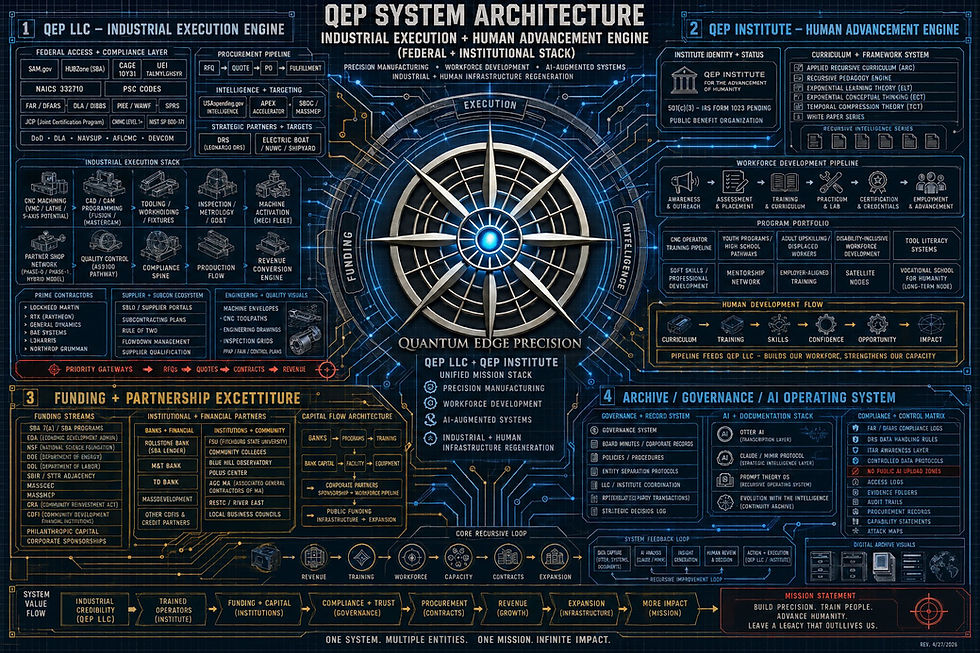
On June 17, QEP reached another federal-access milestone with approval of its Joint Certification Program documentation, commonly associated with DD Form 2345, alongside DLA Enhanced Validation. Those approvals strengthened the company’s supplier-access position and added another layer to the federal infrastructure already built through SAM.gov, CAGE, HUBZone, DIBBS, PIEE, WAWF, SPRS, and the company’s NIST SP 800-171 cybersecurity work.
That progression has taken time because defense manufacturing has layers.
Registering a company is one layer. Accessing procurement systems is another. Technical-data eligibility, cybersecurity, supplier validation, quality systems, quoting discipline, manufacturing readiness, and actual past performance each introduce their own requirements.
During the summer, cybersecurity became one of the clearest areas requiring continued investment.
QEP continued working through the NIST SP 800-171 and CMMC landscape, reviewing system scope, documentation, evidence, asset control, SSP and POA&M development, and the practical cost of building a defense-ready information environment. Policy surrounding CMMC continued to shift during this period, including changes affecting the rollout of third-party assessment requirements, but the direction for QEP remained straightforward: continue improving the underlying cybersecurity system regardless of regulatory timing.
The company also continued using APEX, MEP, federal small-business resources, cybersecurity organizations, and other technical-support channels to understand the next steps before spending heavily on infrastructure that could later need to be replaced.
In August, QEP completed a procurement-readiness assessment that scored the company at 81% overall. The strongest areas included strategy, financial and operational readiness, supplier development, and manufacturing preparation. The weakest category was previous federal contracting experience.
That gap can only be solved one way: earn the work, perform it well, and build the record.
Portland Became a Workload
The NERC Matchmaker produced months of follow-up.
Supplier registrations continued. Agency contacts were revisited. Capability information was routed internally. Manufacturing requirements became clearer. Conversations that began around a table in Portland moved into email threads, portals, scheduled calls, technical discussions, and future-event planning.
The FAA lane continued developing through direct capability-routing conversations following the matchmaker. Defense and aerospace supplier channels remained active. DLA, sustainment, naval, infrastructure, and industrial-base pathways continued to be worked in parallel.
QEP also submitted into additional defense-industrial-base channels during July, continuing to position the company around precision machining, manufacturing engineering, fixtures and tooling, distributed production, supplier coordination, and workforce development.
Then came another major workforce connection.
On July 13, QEP entered the onboarding process for the U.S. Navy Talent Pipeline Program.
The program works directly with manufacturers to strengthen recruiting, onboarding, retention, workforce systems, and long-term talent development. Its operating philosophy of hiring for fit and training for skill fits naturally with the workforce model QEP has been building from the beginning.
QEP joined the New England program network and began planning for continued coaching and a future facility visit. That visit was intentionally delayed as the facility situation evolved. The company has since been invited to the New England Talent Pipeline Program Cohort 4 kickoff and networking event scheduled for September.
The relationship remains active as QEP works through the next version of the manufacturing floor.
By this point, federal engagement had become part of QEP’s regular operating environment.
Six Machines on the Floor Created a Different Problem
By July, six CNC machines were physically installed in approximately 10,000 square feet of manufacturing space in Fitchburg.
That was a milestone years in the making.
It also exposed the next layer of reality.
A manufacturing operation is a system of power, distribution, air, safety, access, inspection, workflow, permitting, people, software, tooling, material movement, and production economics. Putting machines inside a building solves one part of that system.
During the summer, the remaining facility work became increasingly difficult to justify under the existing configuration.
Electrical planning had already required extensive review. Life-safety requirements remained active. Building separation, utility infrastructure, machine access, workflow, timing, activation costs, and landlord coordination continued creating friction.
Eventually, QEP had to look at the situation as an operating decision instead of an emotional attachment to a location.
The company began evaluating other manufacturing spaces.
Several possible facilities were reviewed across the region during August, each with different combinations of square footage, power, sprinkler infrastructure, access, cost, lease structure, and readiness.
By late August, one Fitchburg option had advanced far enough for QEP to begin working directly with the property side and the City through a Letter of Intent, Form of Intent process, parking documentation, and municipal review.
As of early September, that process is still underway.
There is no completed relocation to announce yet.
There is a live facility path being worked through carefully before another rigging operation begins.
Moving six CNC machines is not a small exercise. Door access has to be verified. Rigging has to be planned. Power requirements have to be understood. Municipal requirements have to be resolved. The floor has to make sense before thousands of pounds of equipment start moving again.
The experience has changed the way QEP approaches facility selection.
A building has to support the operation that will live inside it.
That sounds obvious until six machines are sitting in front of you.
The Institute Kept Developing Beside the Manufacturing Work
The QEP Institute for the Advancement of Humanity entered the summer with federal 501(c)(3) recognition already secured.
The next challenge was turning institutional status into useful programs and partnerships.
One of the largest developments came through Corello, an AI-native manufacturing intelligence company that QEP and the Institute had been in dialogue with for months.
During the summer, the relationship advanced into a formal strategic partnership structure between Corello and the QEP Institute.
The agreement creates a path for the Institute to work with Corello’s platform in a bounded educational and evaluation environment while both organizations continue exploring applications involving manufacturing knowledge, workforce development, documentation, and AI-assisted learning.
The next stage is focused on defining an executable pilot rather than leaving the relationship sitting on paper.
Tool Literacy 101 and the Civilization Tools Lab also continued moving forward.
The program was designed as a practical introduction to tools, hardware, measurement, mechanical systems, safety, and physical problem solving for people who may have had little exposure to the trades.
During the summer, conversations expanded around potential host locations and workforce partners. By early September, the Institute had entered planning discussions with Palmer Public Library around a possible Tool Literacy 101 youth pilot for participants roughly 12 to 18 years old.
That program is still in planning. The next steps include in-person coordination, curriculum boundaries, space, supervision, equipment, and the practical structure required to run it responsibly.
There were setbacks as well.
The Institute’s MassCEC Strand C workforce-training proposal was not selected for funding during this cycle.
The program work continued.
That experience has pushed the Institute toward a broader mix of pilot sites, direct partnerships, philanthropic support, workforce organizations, educational institutions, and future grant opportunities rather than relying on a single funding channel.
The Institute now has enough structure to keep testing where its programs fit.
Revenue Strategy Expanded While the Floor Was Being Reworked
The facility transition also forced QEP to examine what the company could sell immediately.
Nearly two decades of CNC machining and programming experience do not disappear because a transformer is not connected or because machines may need to move.
By the end of August, QEP began expanding direct business development around CNC programming and manufacturing support services that can be delivered remotely, on-site, or through hybrid arrangements depending on the customer and application.
The service lane includes CNC programming, G-code output, process planning, setup and prove-out support, troubleshooting, manufacturing engineering assistance, operator support, and temporary or overflow programming capacity.
Outreach began across medical manufacturing, aerospace, defense, semiconductor, and general precision-manufacturing companies.
This gives QEP another route to revenue while the internal production floor is being repositioned.
A manufacturer dealing with programming backlog, a difficult part, an overloaded engineering team, a new machine, a setup problem, or temporary staffing pressure may need experience before they need another long-term employee.
QEP can serve that problem.
The company is now actively pursuing those opportunities while continuing to develop internal manufacturing capacity.
That service lane may remain useful even after the machines are fully active because it expands the company beyond machine-hour capacity alone.
September Begins With a Different Company Than June
A lot has changed since the last Chronicle entry.
JCP approval is active.
DLA Enhanced Validation is active.
HUBZone certification remains active.
Federal supplier infrastructure is significantly further along.
Cybersecurity development continues.
The Navy Talent Pipeline relationship is underway.
The QEP Institute has moved into a formal strategic partnership with Corello and continues developing Tool Literacy 101 through prospective community and workforce pilots.
QEP has opened a direct CNC programming and manufacturing-support revenue lane.
The facility plan is being reworked through an active Fitchburg path rather than forcing the existing setup forward simply because machines had already been moved once.
Hiring at scale remains tied to having a stable floor, production systems, and enough work to support people responsibly.
There are also RFQs, supplier relationships, prospective customers, partner resources, workforce organizations, and federal pathways moving at different speeds around the company.
None of them can be treated as guaranteed revenue.
They are active work.
That distinction becomes increasingly important as QEP grows.
The company has reached a stage where progress is less about collecting another registration and more about converting what has already been built.
Access has to become opportunity.
Opportunity has to become quoting.
Quoting has to become work.
Work has to become performance.
Performance has to become repeat business.
The same conversion now applies to the Institute.
Recognition has to become programming.
Partnerships have to become pilots.
Pilots have to produce useful outcomes.
Useful outcomes have to earn enough trust to expand.
Summer 2026 forced QEP to become more comfortable changing the plan without changing the mission.
That may be the most useful lesson from these last several months.
The original facility plan changed.
The federal environment changed.
Cybersecurity timelines changed.
Funding decisions changed.
Commercial priorities changed.
The company kept operating through those changes.
There are still machines to place, electrical systems to solve, compliance systems to strengthen, customers to win, supplier registrations to finish, workforce programs to develop, and revenue to generate.
There will probably be another revision somewhere in there too.
That is fine.
QEP enters September with a clearer understanding of the operation it is trying to build and a much larger network around it than the company had at the beginning of the summer.
The map changed.
We kept moving.




Comments